Material for MkDocs Is in Maintenance Mode: What It Means for Your Docs
A practical decision guide for staying on Material for MkDocs, testing Zensical, or moving to another documentation stack after maintenance mode.
- Written by
- Puneet Arora (opens in a new tab)
- Published on
- Read time
- 12 min

Material for MkDocs entered maintenance mode after version 9.7.0 ended feature development on November 11, 2025. Maintenance releases continued after that date. The current changelog lists 9.7.7, released July 17, 2026 to fix a search-suggestion vulnerability.
Material for MkDocs remains under critical maintenance through May 5, 2027. Its security policy specifically promises public security fixes for the latest stable version until that date.
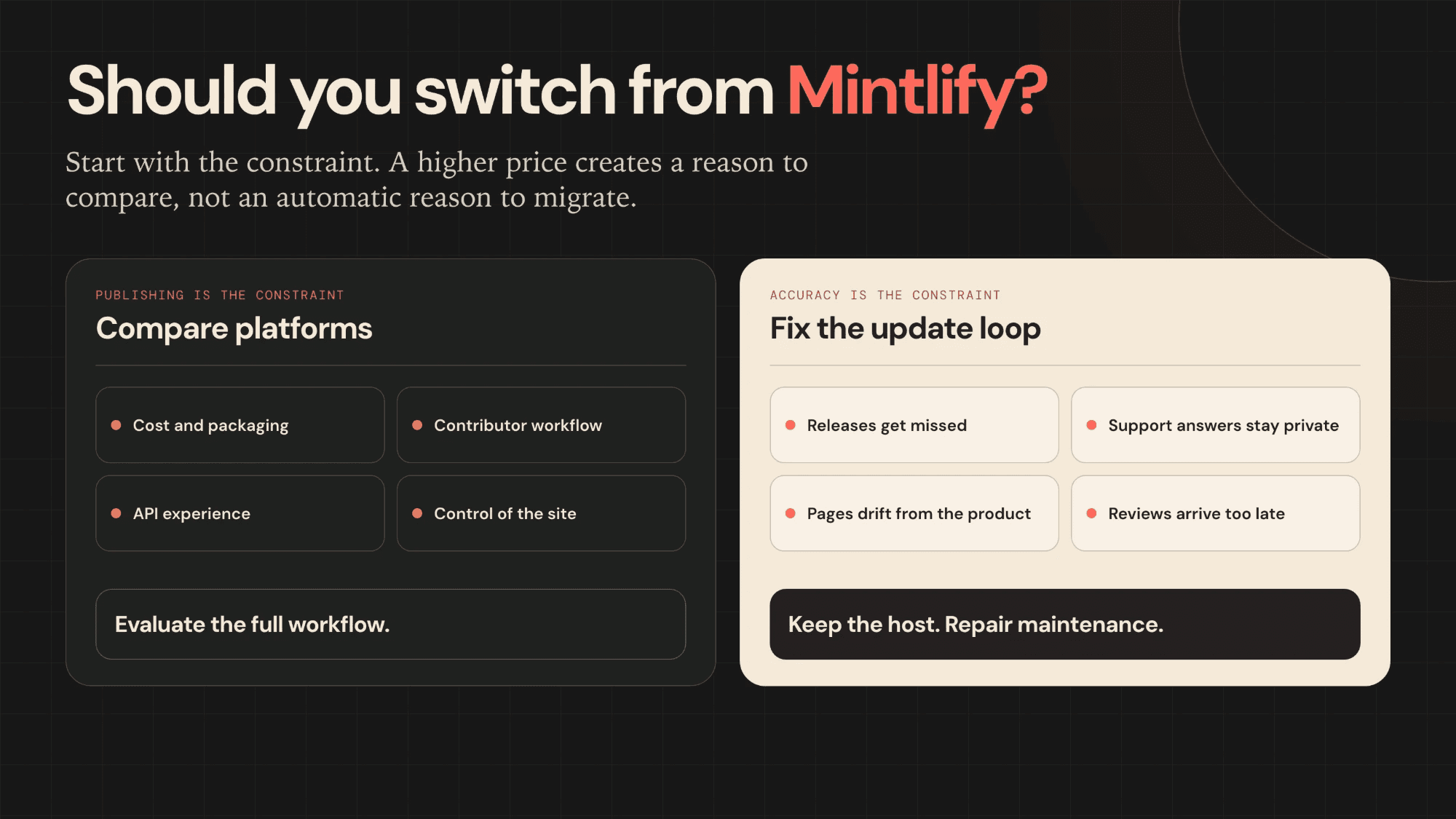
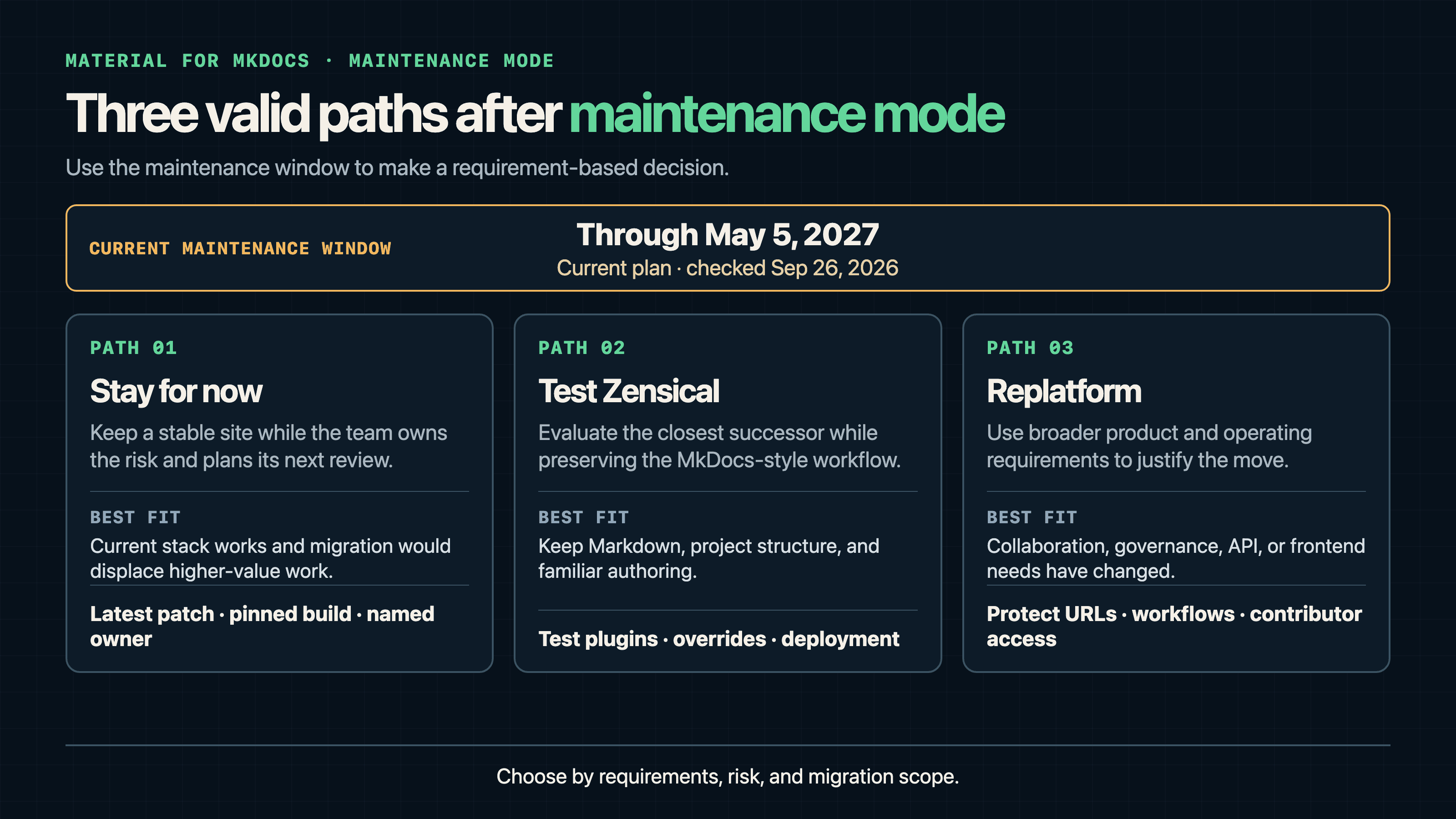
That window gives teams three valid choices: stay with an owned risk plan, test Zensical, or replatform for broader requirements. The renderer choice governs how the site is built and presented. Content accuracy still needs a separate maintenance workflow.
The date changed recently. The original plan pointed to November 5, 2026.
On September 15, 2026, the maintainers extended critical maintenance by six months to May 5, 2027.
November 5 remains a separate milestone because Zensical 0.1.0 is scheduled to launch then. As of September 26, the latest Zensical release is v0.0.65 in the project's 0.0.x alpha series.
TL;DR
- Material for MkDocs remains under critical maintenance through May 5, 2027, with public security fixes promised for the latest stable release until that date.
- Version 9.7.0 was the final feature release. It was not the final maintenance release.
- Staying is reasonable for a stable site when the team keeps the latest patch installed, pins the build, audits dependencies, and owns the risk.
- Zensical is the first successor to test when preserving MkDocs-style authoring and the existing project structure matters. Plugins, settings, commands, and overrides still need compatibility testing.
- Replatform when broader collaboration, governance, API, frontend, or managed-service requirements justify the migration scope.
- Every option still needs a process that connects product changes and support evidence to reviewed documentation updates.
A widely used project is changing direction
The Material for MkDocs project page lists AWS, Bloomberg, Google, Microsoft, and Netflix among industry users, and FastAPI among open source projects using it. PyPIStats reported 11,853,165 downloads in the preceding 30 days when retrieved on September 26, 2026.
Download totals measure package activity rather than active production sites. The practical point is that many documentation teams now face the same planning decision.
What maintenance mode means in practice
New features have stopped
Material for MkDocs 9.7.0 was the final release to receive new features. The maintainers shifted feature development to Zensical.
If your roadmap depends on new theme capabilities, expanding plugin support, or architectural changes, waiting for Material for MkDocs to add them is no longer a plan. Evaluate Zensical or another stack against the requirement.
Critical maintenance has a current end date
The current transition plan says critical maintenance continues through May 5, 2027. The security policy says standard public security updates end after that date.
Teams that stay should remain on the latest stable patch. Calling 9.7.0 the "final version" would be inaccurate because 9.7.1 through 9.7.7 shipped maintenance work after the final feature release.
The deadline does not switch off your site
End of life ends the standard maintenance commitment. It does not disable an existing build or remove an already deployed site.
Risk grows when future dependencies, browsers, Python versions, MkDocs changes, or vulnerabilities require work that the project no longer promises to provide. Your plugin set and deployment environment determine how quickly that risk becomes operational.
Treat May 5, 2027 as the current planning date. Assign someone to watch the security policy, changelog, and transition page because the maintainers have already changed the deadline once.
Option 1: stay on Material for MkDocs for now
Staying is sensible when the site is stable, the current feature set is enough, and migration would displace higher-value documentation work.
Choose this path when:
- The production build is reproducible and covered by CI.
- Your plugins and customizations work on the latest patch.
- The team can monitor security and dependency changes.
- A named owner can revisit the decision before May 5, 2027.
- The current platform is not blocking authors, reviewers, or users.
Do four things now:
- Upgrade to the latest stable 9.7.x release and test the complete production build.
- Pin the build environment so an unrelated dependency release cannot surprise you.
- Inventory plugins, Markdown extensions, theme overrides, custom JavaScript, and deployment steps.
- Record the owner, review date, and conditions that would trigger a move.
Staying preserves migration capacity now, with no expectation of new features and a finite public-maintenance window. A team can remain on Material after May 5, 2027, but that choice requires explicit ownership of dependency and security risk.
Option 2: test Zensical
Zensical is the first successor to evaluate when preserving MkDocs-style authoring matters. It comes from the Material for MkDocs team and can build the same project from its existing mkdocs.yml, which lets teams compare MkDocs and Zensical builds during a gradual migration.
Choose this path when:
- You want to keep the current Markdown and information architecture.
- You prefer the successor maintained by the same team.
- Your required plugins and extensions appear in the compatibility guidance.
- You can run both builds against the same repository and compare the output.
Compatibility determines the actual effort. The migration guide documents differences in settings, commands, template behavior, and project configuration. The plugin compatibility page also lists plugins and settings that are supported, unsupported, replaced, or ignored.
Release maturity belongs in the decision. Zensical v0.0.65 shipped on September 24, 2026. The project describes the current 0.0.x line as alpha and plans 0.1.0 for November 5, 2026 as the start of a dependable release line. The same transition page says Zensical already builds production sites, so the alpha label is a reason to test carefully rather than assume the software is unusable.
Test the full production site. A successful homepage render does not test redirects, search, versioning, generated references, localization, custom components, analytics, or deployment.
Option 3: move to another documentation stack
A broader move is justified when the maintenance notice exposes requirements that Material and Zensical do not address.
Consider replatforming when the team already needs one or more of the following:
- Managed hosting and fewer build-system responsibilities
- A browser-based collaborative editor for non-Git contributors
- React, Vue, or another frontend framework inside documentation pages
- A stronger API reference and SDK publishing workflow
- Enterprise permissions, preview environments, or governance controls
- A different search, analytics, or content-reuse model
- A clean break from Python and MkDocs dependencies
A broader replatform usually has the widest migration scope, although a managed platform may reduce ongoing operating work. The migration may include URLs, redirects, metadata, navigation, search, code examples, embedded components, analytics, and contributor workflows.
One open-source option to evaluate: Potluck Docs
If the move is toward an open-source stack rather than a managed platform, Potluck Docs is worth a look. It is EkLine's MIT-licensed documentation template built on Astro and Starlight, so a team can inspect, fork, and run it themselves with no vendor subscription.
The template pre-wires much of what a MkDocs site would otherwise reassemble by hand: interactive OpenAPI references rendered by Scalar, full-text search, optional private docs behind your own SSO, a sitemap and an llms.txt file generated on every build, a "copy or open in Claude or ChatGPT" menu, and Tailwind v4 theming in one file. Content and hosting stay yours.
Like any self-managed stack, Potluck Docs shifts what you start with, not who operates the site: your team still owns hosting, deployment, and upgrades. You can inspect the live preview and its documentation at potluck.ekline.io and the template repository on GitHub before committing. Because it is Git-backed, the content-maintenance workflow described below applies after a move to it.
Make the move when those gains justify the changes. Maintenance mode alone is too weak a business case.
A decision table for the next planning meeting
| Situation | Best default | Main risk to test |
|---|---|---|
| Stable site, no missing capability, limited migration capacity | Stay for now | Dependency and security ownership after May 5, 2027 |
| Happy with MkDocs-style authoring and the existing project structure | Test Zensical first | Plugin, setting, override, and deployment compatibility |
| Current platform blocks collaboration, governance, API workflows, or frontend requirements | Evaluate a broader replatform | Migration scope, URL preservation, and contributor disruption |
| Nobody owns the decision | Assign an owner before choosing a tool | A manageable transition becomes deadline-driven work |
Use the same acceptance tests for every option:
- Does the full production build pass?
- Are existing URLs and redirects preserved?
- Do search, navigation, versioning, localization, and code samples still work?
- Can the same contributors author and review changes?
- Which pages, components, or integrations need manual work?
- Who owns security and upgrades after the move?
The renderer and the content workflow solve different problems
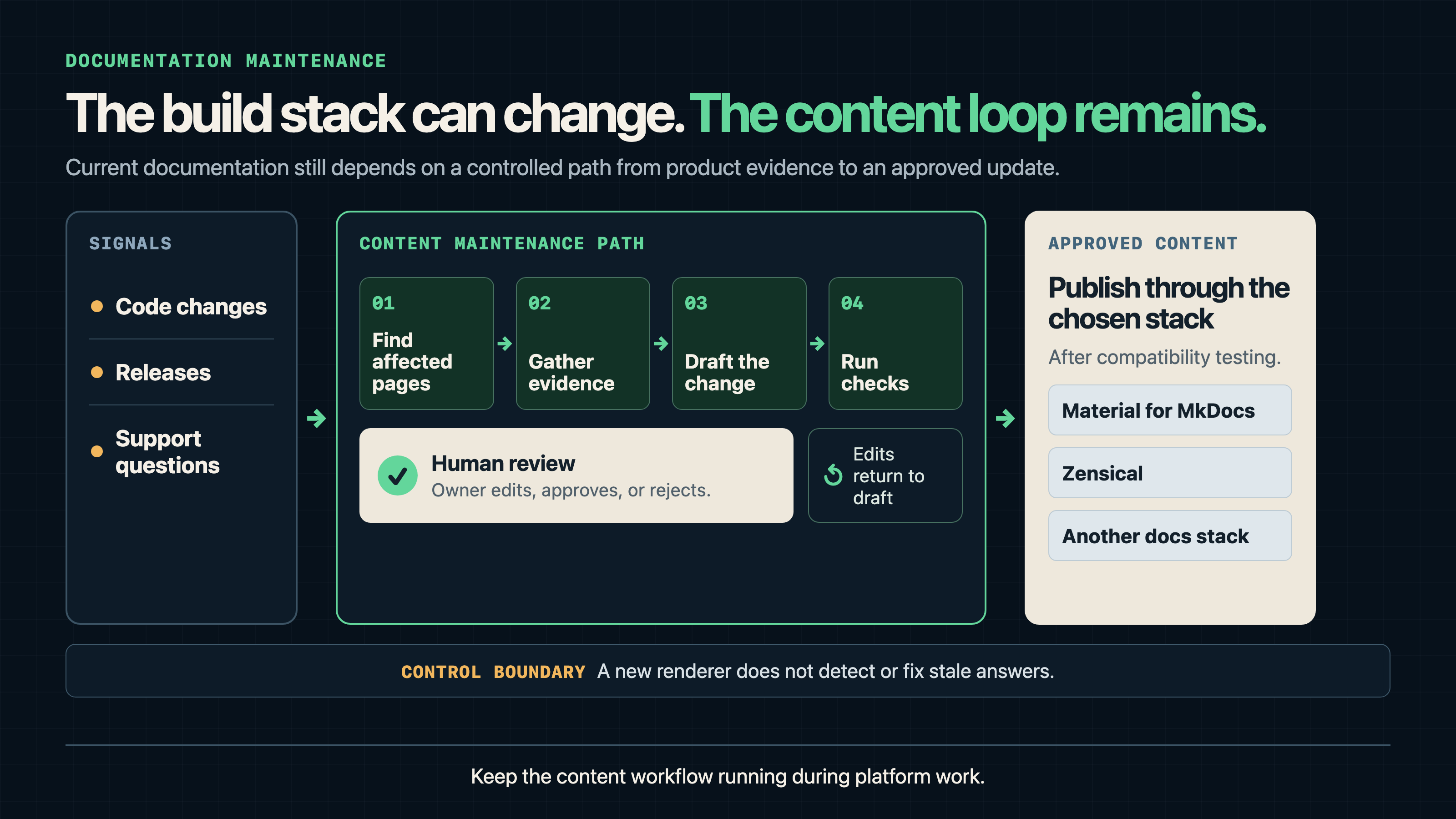
The maintenance announcement concerns the software that builds and presents the site. A renderer can build an outdated page correctly. Teams still need a process that connects product changes and support evidence to reviewed documentation updates.
A product release changes authentication. A support engineer discovers a missing setup step. An SDK deprecates a method. Every platform still needs a maintenance process for those changes.
 (opens the full-size image in a new tab)
A migration can refresh the presentation while leaving accuracy unchanged. Impact analysis, evidence gathering, drafting, checks, and review remain separate work.
EkLine addresses that upstream maintenance workflow. Its GitHub integration can use product-repository changes to prepare updates in a separate documentation repository and open a pull request for review. Automatic PR Review compares code changes with existing documentation and proposes relevant updates. The Docs Agent keeps the output editable and routes publication through the team's normal review process.
That workflow can remain useful when a team changes Git-backed renderers. The output still has to match each stack's content syntax, repository layout, components, and validation rules. Renderer selection and site migration remain separate work.
A practical 90-day plan
Week 1: stabilize
- Confirm the deployed Material for MkDocs version.
- Upgrade and test the current 9.7.x patch.
- Pin the build environment.
- Name the platform decision owner.
Weeks 2 to 4: inventory
- List plugins, extensions, overrides, custom scripts, and deployment dependencies.
- Record the pages and workflows that cannot regress.
- Track documentation debt separately from platform migration work.
Weeks 5 to 8: run two real builds
- Build the current production branch with Material for MkDocs.
- Build the same branch with Zensical or the strongest alternative.
- Compare URLs, HTML output, navigation, search, performance, and contributor workflow.
- Log every manual fix and unsupported dependency.
Weeks 9 to 12: decide and schedule
Choose one explicit outcome:
- Stay through a dated period with an owned risk register.
- Move to Zensical with a tested migration backlog.
- Replatform because broader requirements justify the scope.
Whatever the team chooses, keep content maintenance running during the platform work. A migration that pauses documentation updates can produce a cleaner site with older answers.
Test the content workflow separately from the renderer
If you are planning around the May 5, 2027 deadline, bring one recent release and one recurring support question to an EkLine walkthrough. Test whether EkLine can identify relevant documentation from those inputs and prepare a reviewable pull request in the Git-backed docs repository you intend to keep. Use the result to evaluate content maintenance separately from the renderer choice.
FAQ
Yes. Material for MkDocs remains under critical maintenance through May 5, 2027, and its security policy promises public security fixes for the latest stable release until that date. On September 15, 2026 the maintainers extended the window by six months from the original November 5, 2026 date.
Version 9.7.0 was the final feature release, not the final release. Maintenance releases continued after it, and the changelog lists 9.7.7, published July 17, 2026 to fix a search-suggestion vulnerability. Calling 9.7.0 the final version would be inaccurate.
No. Maintenance mode gives teams a planning deadline rather than an emergency migration. There are three valid paths: stay for now with an owned risk plan, test Zensical, or replatform when broader requirements justify the work.
Zensical is the successor from the Material for MkDocs team. It can build the same project from its existing mkdocs.yml, which lets teams compare MkDocs and Zensical builds during a gradual migration. As of late September 2026 the current release is v0.0.65 in the 0.0.x alpha series, with 0.1.0 scheduled for November 5, 2026.
No. End of life ends the standard maintenance commitment. It does not disable an existing build or remove an already deployed site. Risk grows only when future dependencies, browsers, Python versions, MkDocs changes, or vulnerabilities require work the project no longer promises to provide.
Potluck Docs is one option. It is EkLine's MIT-licensed documentation template built on Astro and Starlight, so your team can inspect, fork, and run it without a vendor subscription. It pre-wires interactive OpenAPI references, full-text search, optional private docs behind your own SSO, and a sitemap and llms.txt generated on every build. Like any self-managed stack, your team still owns hosting, deployment, and upgrades. A live preview and its documentation are at potluck.ekline.io.
Sources
- Zensical: A modern static site generator - Material for MkDocs maintainers, published November 5, 2025; checked September 26, 2026.
- Material for MkDocs changelog, including 9.7.0 through 9.7.7; checked September 26, 2026.
- Commit extending critical maintenance to May 5, 2027, dated September 15, 2026; checked September 26, 2026.
- Material for MkDocs security policy; checked September 26, 2026.
- Zensical transition timeline; checked September 26, 2026.
- Zensical migration guide for MkDocs projects; checked September 26, 2026.
- PyPIStats recent-download API response for
mkdocs-material; retrieved September 26, 2026. mkdocs-materialproject page and maintainer-supplied user list; checked September 26, 2026.- EkLine GitHub integration documentation; checked September 26, 2026.
- EkLine Docs Agent overview; checked September 26, 2026.
- Zensical v0.0.65 release, published September 24, 2026; checked September 26, 2026.
- Zensical MkDocs plugin compatibility; checked September 26, 2026.
- EkLine Automatic PR Review documentation; checked September 26, 2026.
- Potluck Docs live preview and documentation and its template repository; checked September 27, 2026.